


Groundwater is a hidden connection between land and ocean.
We investigate how global change alters coastal groundwater, what this means for freshwater resources and marine ecosystems, and how science can support effective adaptation.
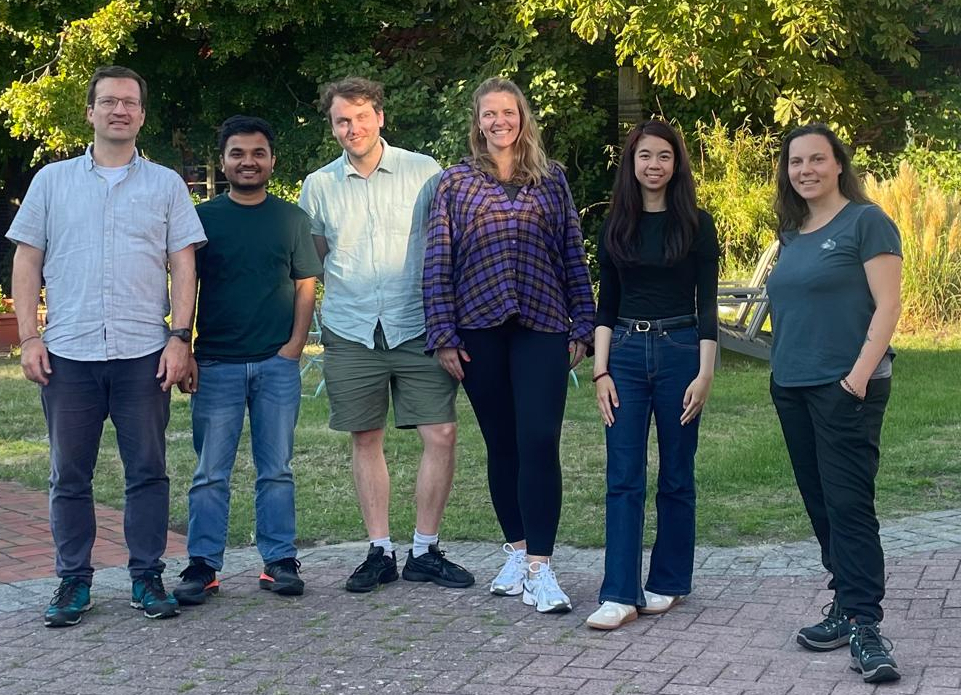
The Coastal Groundwater Working Group on its 2026 summer retreat
Groundwater connects a changing Earth system
Groundwater is often out of sight, but it is not isolated. It exchanges water and dissolved substances with soils, rivers, wetlands, the atmosphere and the ocean. Global change alters these connections through sea-level rise, changing rainfall and recharge, extremes, land use and groundwater abstraction. The consequences extend from changing freshwater availability to changing groundwater quality or nutrient and carbon transport with consequences for coastal ecosystems and human societies.
Our research makes these hidden connections visible and quantifies how they change across space and time — from individual beaches and islands to regional and global groundwater systems.
Our research themes
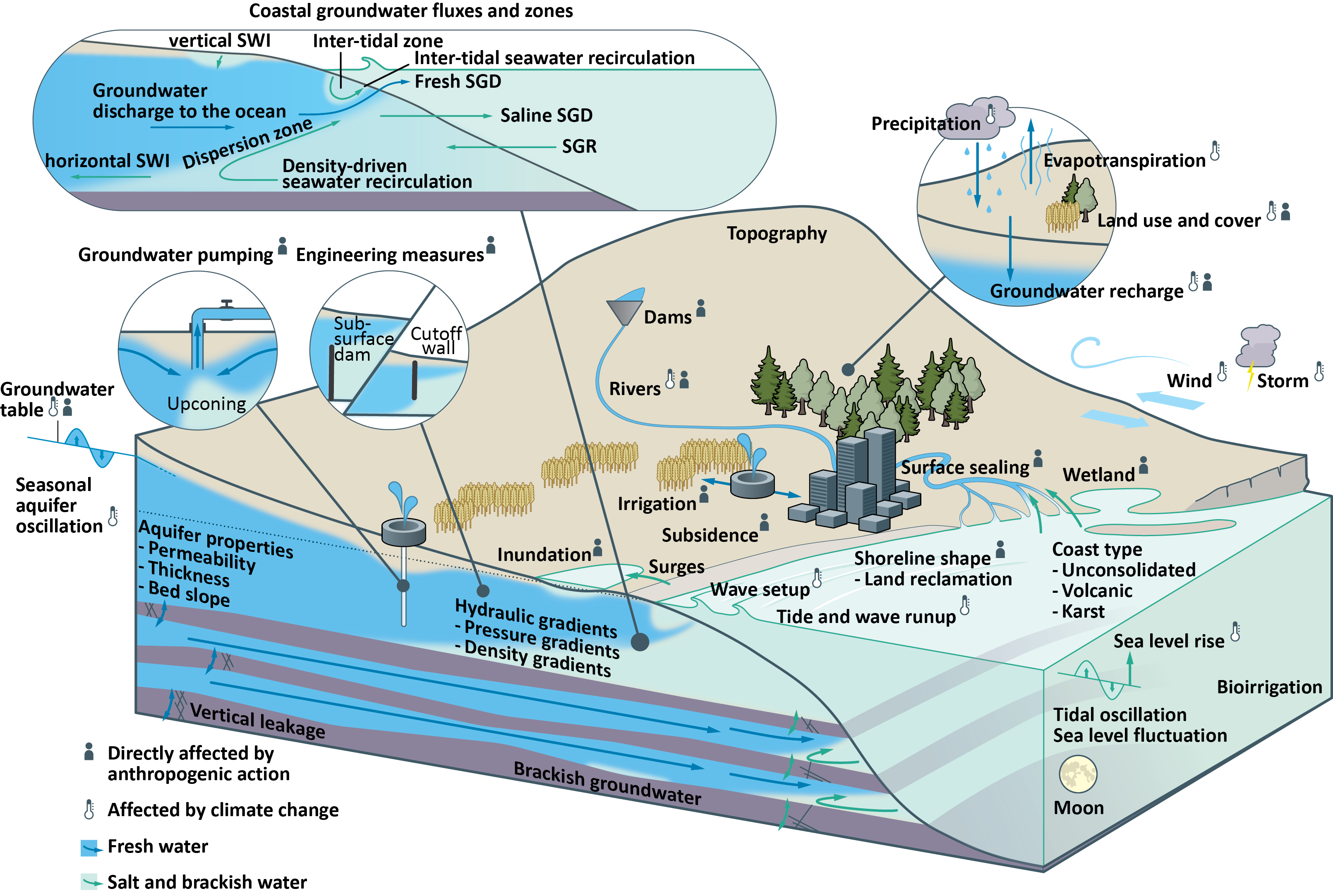
Our perceptual model of coastal groundwater (figure from: Kretschmer, D.V., Michael, H.A., Moosdorf, N., Oude Essink, G.H.P., Bierkens, M.F.P., Wagener, T., Reinecke, R., 2025. A Perceptual Model of Drivers and Limiters of Coastal Groundwater Dynamics. Hydrological Processes, 39(1): e70058.)
Groundwater in the changing Earth system
We examine groundwater as part of the integrated Earth System. Our work addresses groundwater recharge and storage, exchanges with surface waters (mostly the ocean), and the representation of groundwater in models of global environmental change. We connect lab experiments and local observations with regional and global analyses to identify patterns, feedbacks and uncertainty, and we produce large scale data to improve the foundation of our global models — the basis for more reliable assessment, science-based policy and adaptation.
Coastal aquifers under global change
At the coast, fresh groundwater and seawater meet in dynamic aquifers. Sea-level rise, changing rainfall and recharge, extremes, pumping, land use and coastal morphology can alter this balance. We study saltwater intrusion and submarine groundwater discharge to understand where coastal freshwater is particularly vulnerable or relevant, and how risks develop over time.
Consequences of submarine groundwater discharge in the integrated Earth System
Groundwater crosses the shoreline at the seafloor. This submarine groundwater discharge can transport freshwater, nutrients, carbon, trace elements and contaminants to the coastal ocean. We investigate where these fluxes occur how they are transformed in subterranean estuaries, and how they are coupled to other compartments of the Earth System, like coastal ecosystems or the marine realm.
How we work
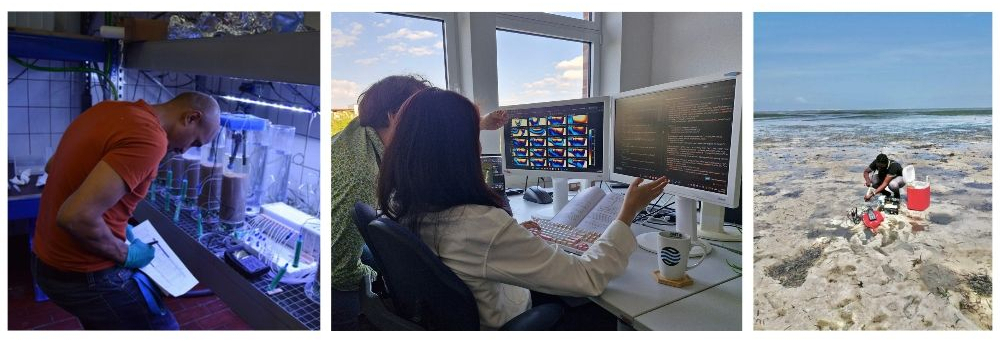
We combine field measurements, hydrogeology, geochemistry, geophysics, remote sensing, process-based numerical and empirical modelling and conceptual studies.
Tracers such as radium isotopes integrate groundwater inputs over coastal areas, while wells, sensors and seepage measurements resolve local conditions.
Thermal imagery and geophysical surveys reveal spatial patterns, models connect observations across scales and test future scenarios and conceptualizations reveal relevant processes.
Across regions and scales
Our work is rooted in tropical coasts and islands, where groundwater can be crucial for communities and ecosystems and where observations remain sparse. We work in South- and Southeast Asia, in Western and Eastern Africa, as well as parts of Latin America and the Caribbean. Another major part of our work is global scale modeling and data acquisition. By linking detailed field investigations with synthesis, large scale data products and modelling, we identify place-specific processes and patterns that matter beyond a single site.
Work with us
We welcome collaboration with colleagues across hydrology, hydrogeology, oceanography, biogeochemistry, ecology, climate science and coastal management. MSc students can approach us about thesis topics contributing to ongoing research. We welcome guests. If you want to join us on a fellowship (e.g. from DAAD or AvH) please contact us. Note that we do research strongly guided by values and expect us to follow a code of conduct.
Our goal is to understand groundwater’s role in the Earth System well enough to explain present-day consequences, anticipate future risks and support effective adaptation in coastal regions from global to local scale.
 WG Members
 Programme Area
 Publications WG Coastal Groundwater
 Policy Briefs
 Research Projects
 On Going