



The WG Earth Surface and Eco-Evolutionary Dynamics is broadly interested in how lifeforms and their physical environment interact to shape biodiversity patterns across spatial and temporal scales. We combine process-based modelling and statistical analysis with various observations to study the interactions of biological and physical processes. We have a special interest in characterising functional diversity patterns of terrestrial and aquatic organisms, as well as modelling the co-evolution of life and landscapes.
Tropical coastal ecosystems in Earth System Models
We focus on improving the representation of tropical coastal ecosystems in Earth System models as part of the institute extension called TropEcS. A key development is the extension of the ICON land surface model component (JSBACH4) to include a tropical coastal wetland vegetation, in particular, mangrove forests. To assess the impact that this vegetation component has on the global carbon fluxes.

The figure shows a schematic with the main components included in the ICON-Land (JSBACH4) model, together with general diagnostic outputs.
Functional biogeography
We study the macroecological patterns of aquatic and terrestrial organisms with a special focus towards functional biogeography. Thus, we seek to bring light to the mechanisms controlling functional trait variability across temporal, spatial, and ecological scales. Some examples include the analysis of the biogeographic patterns of phytoplankton, marine megafauna, soil nematodes and, more recently, mangrove plants using a combination of observations, process-based models, and statistical approaches.
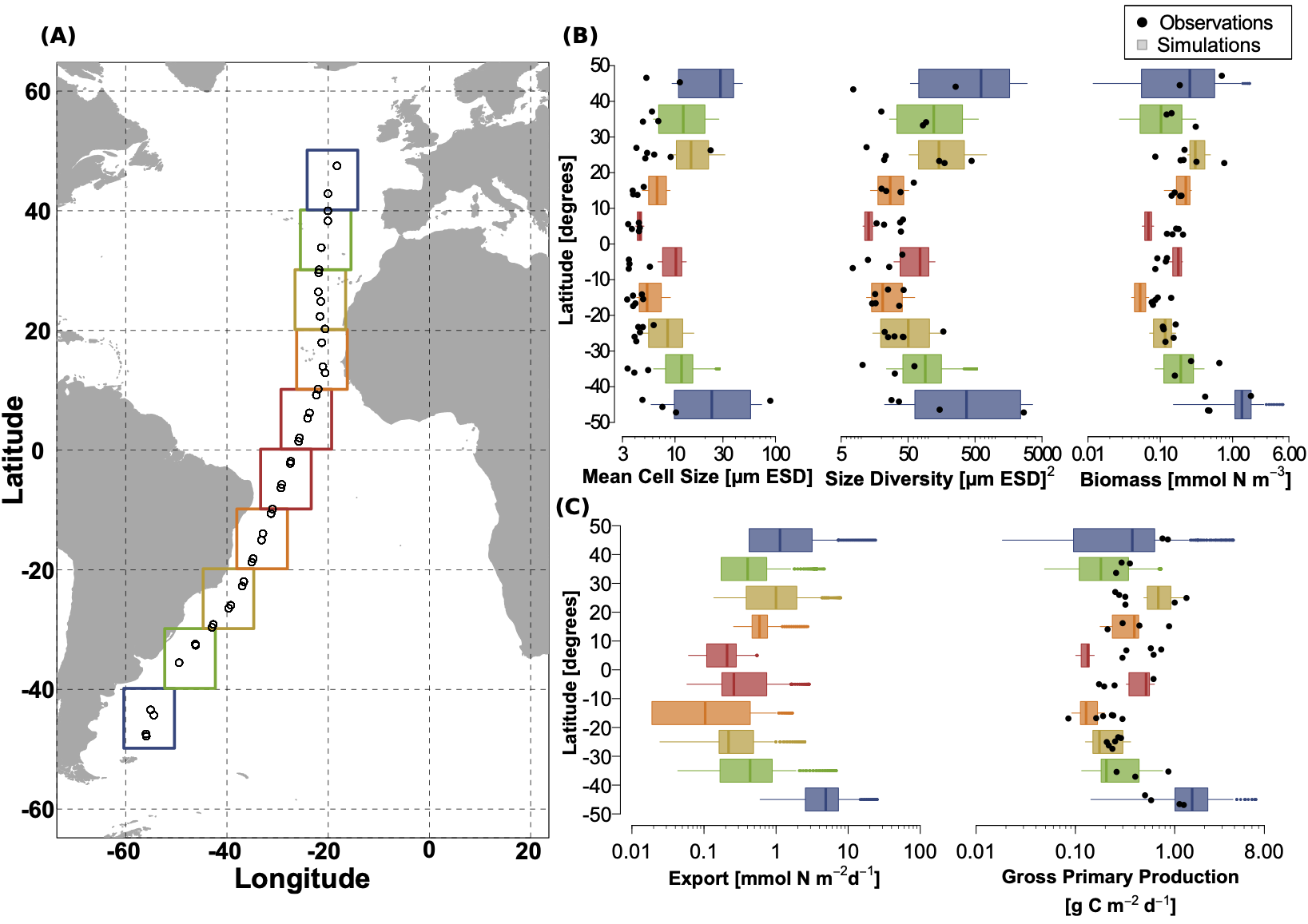
The figure shows an analysis of the functional diversity patterns of phytoplankton along a latitudinal gradient.
Co-evolution of life and landscapes
We investigate how life, climate, and landforms interact to shape biodiversity patterns over geological time. We approach this using a coupled eco-evolutionary and landscape evolution model we developed, called AdaScape. We use this tool together with analysis of various observations to untangle the links between geological history and evolutionary patterns in high-relief areas and, more recently, in insular landscapes. For more information, see our repo and our publication describing our main numerical modelling tool.
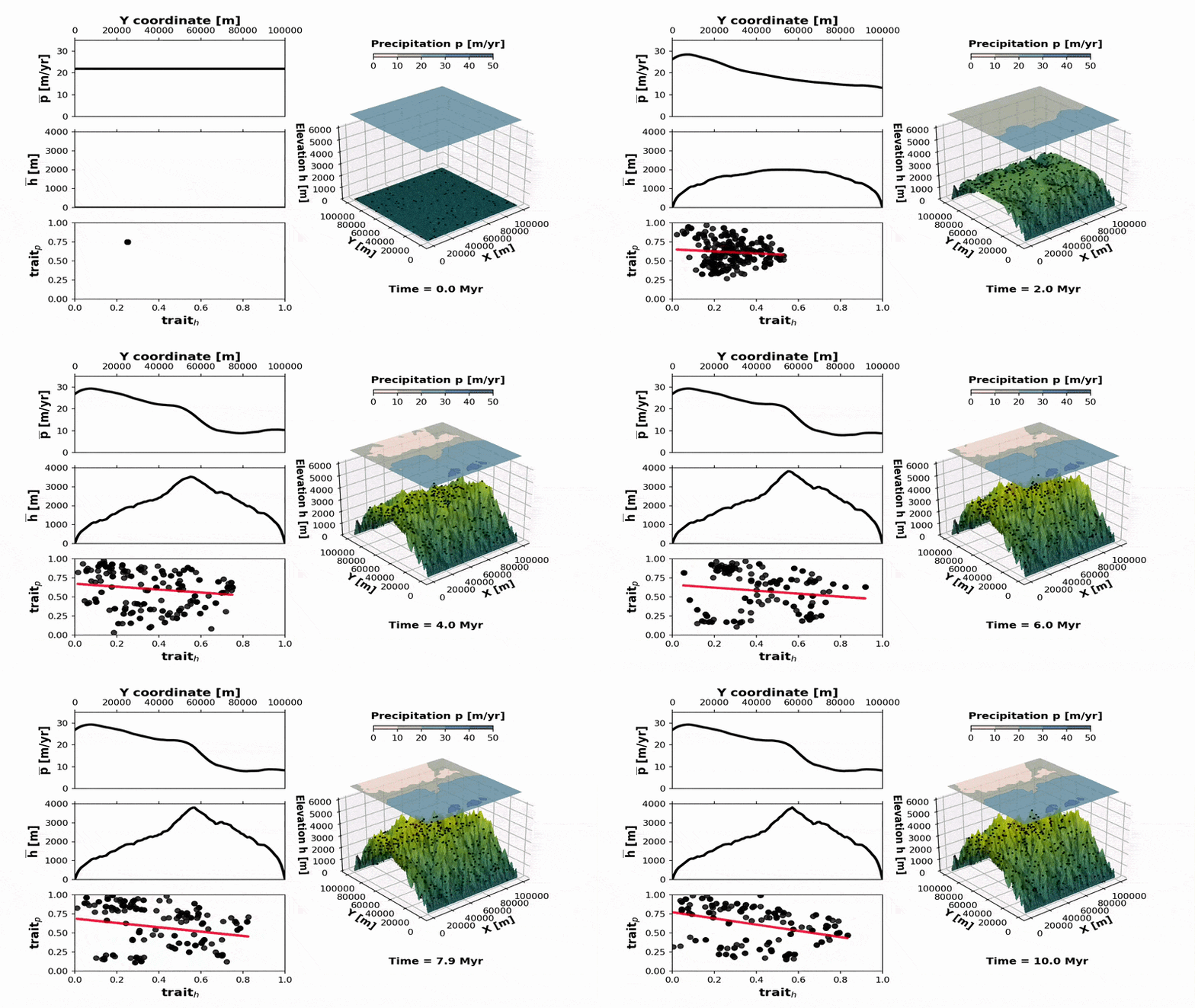
The animation shows a simulation result using AdaScape, where organisms adapt their trait values to changes in precipitation and elevation.
 WG Members