



WHAT WE DO
We aim to understand the functioning of present and future reef systems. We investigate what promotes or supports reef integrity, biodiversity, and the benefits reefs provide to people. We ask why and how are reefs changing and how are these changes reconfiguring reef-human connections. We study what underpins the natural survival of reef building corals in a changing world whilst embracing the emergence and persistence of non-coral dominated reefs. With this knowledge we seek to orient both conventional and proactive strategies of reef conservation and restoration.
RESEARCH THEMES
CURRENT PROJECTS
2026-2031 SEASTRONG
2025-2030 COLDEMAR
OUR LATEST FINDINGS
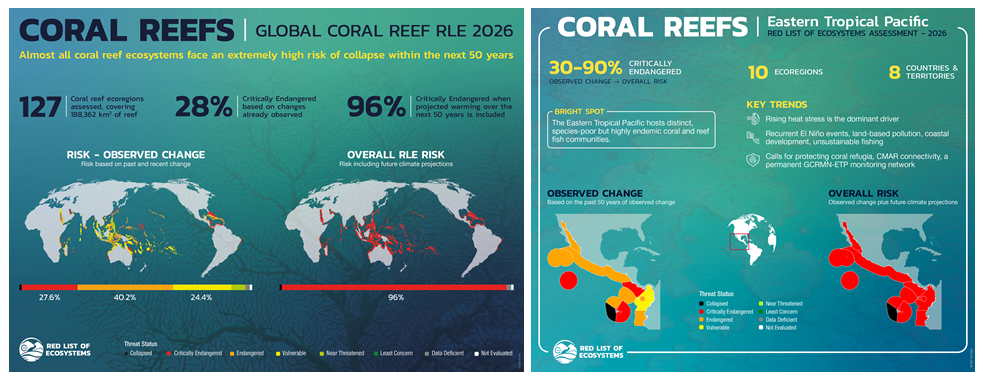
As part of the Global Red List of Ecosystems Assessment, we assessed the reef risk of collapse for coral reefs in the Eastern Tropical Pacific.
Coral reefs in the Eastern Tropical Pacific are naturally small and isolated, yet resilient. Our assessment points at heat stress associated to ongoing global warming as their primary threat, followed by the small area they occupy. Nine out of ten ecoregions are in critical risk of collapse and the tenth (West Galapagos) is considered long collapsed, following the 1982-83 El Nino bleaching event. Preventing further collapse hinges on reducing greenhouse gases globally, controlling sources of local reef damage, and strengthening regionally coordinated climate-adaptation planning.
This report was launched at the CBD COP17 in Yerevan Armenia (see here), as well as covered by The Guardian, Der Spiegel, NY Times, and others.





 WG Members
 Publications WG Reef Systems
 Research Projects