


Thematic focus
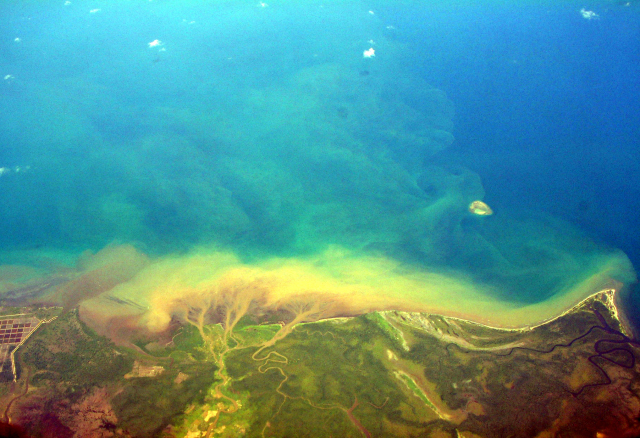
Coasts are dynamic transition and transformation zones where socio-economic, political, institutional, and environmental processes interact. Materials move from catchments to the coast through (sub)surface pathways, undergoing transformations along the land–ocean continuum. Together with social, political, and infrastructural processes across scales, these interactions connect human interventions in the ‘hinterland’ with environmental and societal change in coastal areas. Understanding and managing these coupled processes is essential for environmental quality and human well-being.
Coastal ecosystems regulate the transport, transformation, and storage of carbon, nutrients, and pollutants, providing critical ecosystem functions and services. At the same time, intense anthropogenic pressures and social-ecological vulnerabilities create challenges and opportunities for transformative solutions. ‘Blue Carbon’ is increasingly relevant to climate mitigation and adaptation, requiring improved understanding of carbon accumulation, storage, and the equitable distribution of costs and benefits.
'Coastal Transformation' describes dynamic changes in social-ecological systems driven by interacting drivers and feedbacks from local to global scales, including land-use change, hydrology, coastal development, and societal practices. PA3 contributes to the protection and sustainable use of tropical coastal ecosystems by analysing land–ocean material and intangible fluxes, their pathways and transformations, and their environmental and societal consequences.
Using the 'source-to-sea' continuum as a unit of analysis, PA3 investigates connectivity from catchments through surface and subsurface systems to estuaries and coastal seas, integrating hydrological, ecological, biogeochemical, social, economic, and governance processes. PA3 examines both fluxes and stocks, exploring how materials, knowledge, values, and practices are transformed across landscapes, ecosystems, cultures, and institutions, and how cumulative changes can shift systems towards new states.
Research combines field observations, experiments, numerical modelling, and participatory approaches to assess coastal sustainability, vulnerability, resilience, and pathways for transformative and just change. Key areas include sustainable coastal tourism, blue carbon stocks and markets, and the interconnected health of people and ecosystems (’one health’), with emphasis on connectivity between land and sea, disciplines and scales, and science and society.
 Contacts
 Publications Programme Area 3
 Working Groups
 Former Working Groups
 Research Projects
 Research Projects (completed, selection)
 News / Current
 Events