



DNA analysis sheds new light on the gill microbiome of coral reef fish
A recent genomic study of coral reef fish by scientists from the Leibniz Centre for Tropical Marine Research (ZMT) and the Institute for Chemistry and Biology of the Marine Environment (ICBM) at the University of Oldenburg has found previously undescribed microorganisms in the fish gills that can carry out a wide variety of metabolic functions. Most prevalent among them was a novel lineage of proteobacteria with chemosynthetic potential, which is the ability to fix carbon dioxide using energy produced by the oxidation of inorganic compounds. Chemosynthetic bacteria have been documented in different marine environments or in association with invertebrate hosts such as annelid worms and molluscs but are most likely a new discovery in fishes. The new findings show that fish gills host a complex and specialized microbiome that is not well understood yet but could play an important role in fish metabolism, immunity and health. The study has just been published in the journal PLOS Genetics.
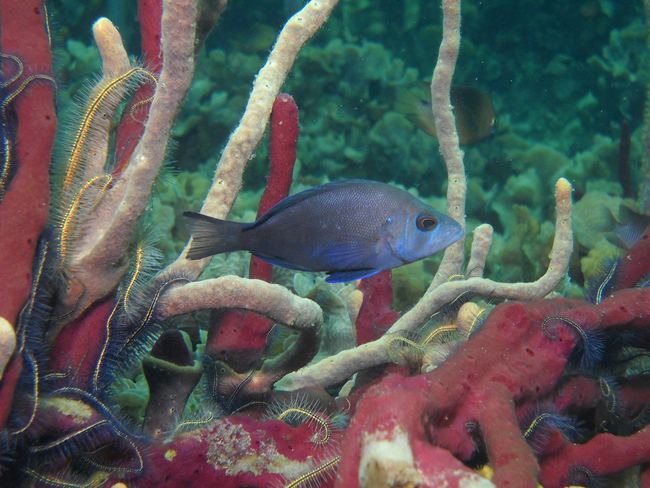
Scientists from ZMT and ICBM have taken a closer look at the microorganisms living in the gills of coral reef fishes. They used data from previous genomic studies of tropical reef fish called hamlets (Hypoplectrus spp.) from across the Greater Caribbean for which they had examined hundreds of gill samples.
As part of that process, the team sequenced the entire DNA in the tissue samples, the so-called metagenome, and ended up with a large treasure trove of data including fish DNA, but also DNA from the microorganisms that live in the gills.
The researchers’ initial plan had been to discard the microbial DNA and use the sequenced fish DNA to study the evolution of the hamlets, which they did. But then they decided to revisit the dataset with a different perspective.
“In the past we solely focused on fish DNA for our work and considered microbial DNA as contaminants”, recalls Oscar Puebla, fish ecologist at ZMT and Professor of Fish Ecology at the University of Oldenburg. “One day we thought, why don’t we take the opposite view, look at the gill microbiome and neglect the fish DNA.”
The new direction led to different research questions for the team which also included colleagues from the Helmholtz Institute for Functional Marine Biodiversity (HIFMB) in Oldenburg and from the Universities of Hong Kong and Chicago.
“Our new plan was to identify which microorganisms live in the gills of the hamlets and thus shed light on the gill microbiome which scientists do not yet know much about,” says Sabrin Abdelghany, former PhD student at ZMT and lead author of the study.
Her co-author Martin Helmkampf from ZMT adds: “The gills are a major interface between the fish body and the external environment. They are not only important for gas exchange during breathing but also for fish immunity, excretion of waste and metabolic products, as well as body pH and salinity regulation.”
Further insights into the gill microbiome: Small fraction of DNA data reveals new bacterial groups in the fish gills
The scientists found that more than 95% of the DNA extracted from the gills came from the hamlet hosts, with microbial DNA accounting for less than 5% of the data. Yet this small fraction was enough for the researchers to discover something new about the fish gill microbiome.
The researchers managed to reconstruct 70 bacterial genomes from 17 bacterial groups and found that the vast majority of these are new to science. They could also show that the gill microbiome was completely different from the community of microorganisms that live in the surrounding seawater, suggesting that the gill microbiome is specialised to live on the gills as opposed to being a mere reflection of the seawater microbiome with which the gills interact.
Puebla says: “The genes in these new bacterial genomes indicate that the microorganisms found in the gills can carry out a wide variety of metabolic functions, including many potential metabolic interactions both among different bacteria and between bacteria and the fish.”
Much to their surprise, Puebla’s team also observed that the most widespread bacteria in the gills have all the genes required for chemosynthesis, which is the ability to fix carbon dioxide using energy derived from the oxidation of inorganic compounds rather than from sunlight, as plants do.
“We detected the DNA of proteobacteria of the Burkholderiaceae family with chemosynthetic potential”, says Sabrin Abdelghany. “Bacteria with such chemosynthetic abilities have been found in a variety of marine environments such as deep-sea vents or in association with invertebrates like annelid worms and molluscs, but to the best of our knowledge they have not been documented in fishes.”
The gills host a complex and specialized microbiome that is still poorly understood, but which could potentially play a role in fish metabolism, immunity and health, the authors conclude. Their new findings now raise further questions generating challenging new research topics for the team.
Helmkampf likens the experience to “walking through a jungle for the first time, starting to describe the organisms that live there and wondering how they may interact.”
Puebla concludes: “We are clearly still at an exploration and discovery stage, and know almost nothing about the gill microbiome’s importance for fish physiology and health. This is relevant in both aquaculture environments and natural populations that are facing rapid environmental change.”
Publication:
Abdelghany S, Helmkampf M, Schechter MS, Veseli IA, Leray M, Eren AM, et al. (2026) Proteobacteria with chemosynthetic potential are highly prevalent in the gills of Hypoplectrus reef fishes. PLoS Genet 22(8): e1012266. DOI: https://doi.org/10.1371/journal.pgen.1012266
 Contacts
  Programme Areas
  Working Groups