


How seabirds, coral reefs and native forests can help tropical atoll islands adapt to sea-level rise
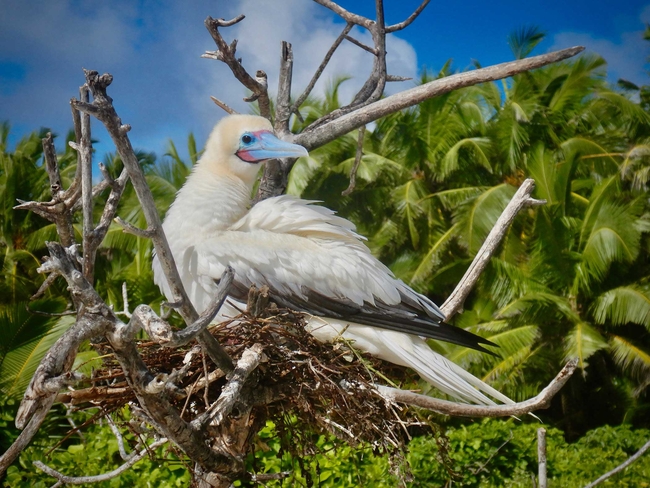
Protecting seabirds and restoring native vegetation could help tropical atoll islands adapt to rising sea levels according to a new study by an international research team led by Lancaster University, with contributions from the Leibniz Centre for Tropical Marine Research (ZMT) in Bremen. Published in the journal Science Advances, the study examines how nutrients brought to tropical islands by seabirds affect the islands and their surrounding coral reefs, and what this means for their ability to adapt to sea-level rise.
As global warming continues, sea levels are rising, increasing the risk of flooding for low-lying reef islands in the Indian and Pacific Oceans. Controlling rat populations to protect seabirds and restoring native vegetation could help promote the natural growth of these islands.
“Replacing old, abandoned coconut palm tree plantations with natural vegetation, and restoring seabird populations by eradicating invasive rats, could be key to the survival of these tiny low-lying islands,” explains lead author Distinguished Professor Nick Graham of Lancaster University. “Atoll islands are not static; they are naturally active systems that can change and adapt to their environmental conditions if they are allowed to do so.”
Graham adds that the findings show how healthy seabird populations, protected from invasive species such as rats, together with intact native forests, could help atolls keep pace with the sea-level rise projected by the end of the century under a global warming scenario of 2°C.
Three natural mechanisms that protect atoll islands
The researchers combined ecological datasets for 28 Indian and Pacific Ocean atoll islands across the Seychelles and the Chagos Archipelago in the Indian Ocean, and Tetiaroa atoll in French Polynesia, in the Pacific.
By looking at seabird census data, the researchers estimated the amount of ‘energy’ seabirds are bringing from the open ocean back to each of the small atoll islands and how the nutrients - deposited in seabirds’ droppings - influence the islands and their surrounding marine ecosystems.
They found that the presence of seabirds and native vegetation has a positive boosting effect on three key processes that support atoll island resilience to sea level rise:
- coral reef growth
- sediment production
- and soil stabilisation
ZMT investigated how corals and other reef organisms help sustain tropical atoll islands
Dr Marleen Stuhr from the Leibniz Centre for Tropical Marine Research (ZMT) contributed to the study working with scientists from the University of Exeter. They analysed how corals and other reef organisms contribute to calcium carbonate reef framework production and sediment generation in the Chagos Archipelago in the central Indian Ocean.
The team measured calcium carbonate production by corals and encrusting calcifying algae and sediment production by parrotfish, sea urchins and other organisms. In addition, the researchers studied the metabolism of living corals and could demonstrate how nutrient inputs from seabirds are linked to coral reef productivity and calcium carbonate production.
Previous studies have shown that seabirds play a vital role in recirculating nutrients from the open ocean where they feed, to the islands where they roost, breed and nest.
Marleen Stuhr explains: "Seabirds connect the open ocean with islands and their coral reefs. They transport nutrients from the sea to land, from where these nutrients enter the surrounding reefs and enhance their productivity. Our research shows how these nutrient inputs can influence calcium carbonate production and coral reef growth. At the same time, sediments are generated within the reefs, helping to sustain the islands. The new study highlights how closely these processes are interconnected and how important protecting and restoring natural seabird populations could be for the resilience of tropical islands to sea-level rise."
Seabird populations and native vegetation under pressure
However, many tropical islands have now lost their seabird populations due to a combination of lost roosting habitats and predators in the form of invasive rats which arrived as stowaways on boats in previous centuries decimating bird populations.
Many atolls have also seen their native vegetation stripped away and land converted to development or crops, with coconut plantations now estimated to dominate around 60% of Pacific atoll forests.
Coral reefs grow faster around islands with abundant seabirds
Reef growth is key to reducing wave-driven erosion of island coastlines.
The researchers found that corals grow much faster on reefs around islands with healthy seabird populations compared to bird-free islands. These nutrient-enhanced corals also calcified faster, forming more hard reef substrate.
Using these data, the researchers calculated the ‘reef accretion potential’ for the islands, revealing how conservation measures, such as rat eradication might influence the overall reef growth.
They found that reef growth rates on lagoonal and ocean-facing reefs around rat-free islands, and therefore with abundant seabird populations, were 1.8 and 2.5 times greater respectively than reefs around rat-infested islands.
Accretion rates for rat-free bird-populated lagoonal reefs could therefore be sufficient to keep pace, to a large extent, with the sea-level rise projected by the end of the century under a 2°C global warming scenario.
Such reef growth would also help reduce wave energy and, consequently, coastal erosion. Without seabird populations, however, reef growth would probably have limited ability to keep up with projected sea-level rises.
More sediment to sustain the islands
Reefs fertilised by seabird nutrients also enhanced another key process on the surrounding reefs: the production of sediments that can build or maintain islands. Sediment production potential due to greater parrotfish biomass and other organisms that produce sediments was substantially higher for islands with seabirds, with an estimated 2.3 to 2.8 times higher sediment production rates on lagoonal and ocean-facing reefs around seabird populated islands.
For a small island of around 14 hectares, this translates to approximately 170 cubic metres more sediment being produced on the surrounding reefs every year, which could help maintain and expand the island.
Native vegetation protects against erosion
The researchers also looked at the role of native plants and trees in stabilising atoll island soils and sediment.
Native plants and trees, which have long and dense root systems, help to lock sediment in place and prevent it being eroded. This contrasts with the coconut trees historically cultivated on many atoll islands, which have a much less effective root system for binding and holding soils and sediment.
The team estimated fine root length to be 4.6 times higher in areas of high native vegetation compared to areas with low amounts of native vegetation, significantly increasing soil binding potential and demonstrating the importance of restoring native vegetation on atolls.
The study also shows when seabirds are present, the root systems of these native plants are also enhanced.
The findings suggest that rewilding of atolls can help their climate resilience.
Dr Jennifer Appoo, of the University of the Seychelles, also a co-author on the study, said: “Our results show new evidence that island restoration is not only beneficial to biodiversity conservation but can enhance the resilience of low-lying atoll islands in the face of sea-level rise, particularly where costly engineering solutions are unfeasible or inappropriate, as can be the case in countries with uninhabited or sparsely inhabited atolls, such as Seychelles.”
Publication:
Nicholas A. J. Graham et al., Seabirds and native vegetation drive ecosystem processes that support atoll island resilience. Sci. Adv.12, eaei1145 (2026). DOI: 10.1126/sciadv.aei1145.
Link: https://www.doi.org/10.1126/sciadv.aei1145
 Contacts
 Programme Areas
 Working Groups