
m-CONNECT: EU-funded project takes a connectivity-focused approach to coral reefs, mangroves and seagrass meadows
Twenty interdisciplinary partners from 12 countries in Europe, Island Southeast Asia and Melanesia will begin work on a four-year landmark project in September 2026. Funded by Horizon Europe with a budget of six million Euros, the project “Management of Coastal Networks Nurtured through Ecosystem Assessment, Collaboration and Technology”, or m-CONNECT, will focus on coral reefs, mangrove forests, and seagrass meadows as interconnected coastal ecosystems that are vital for biodiversity, climate resilience and human wellbeing. The project is coordinated by the Leibniz Centre for Tropical Marine Research (ZMT) in Bremen, Germany.
m-CONNECT: A project responding to coastal and global challenges
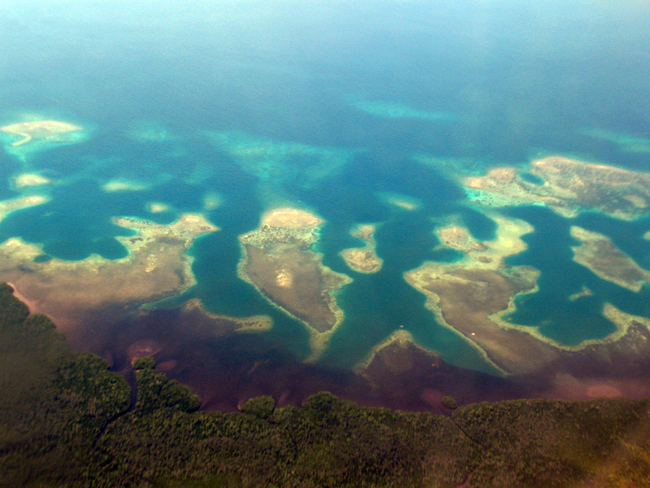
Coral reefs, mangrove forests and seagrass meadows are connected to each other, forming a “Tropical Triad” of coastal ecosystems. Jointly providing essential ecosystem services such as natural resources and coastal protection, the Tropical Triad is essential for the wellbeing of coastal communities. While traditional research and management approaches have largely considered each ecosystem separately, a better understanding of the ecological and social connections within the Tropical Triad – and how they respond to change – is essential for integrated biodiversity protection. It is also key to unlocking the Triad’s full potential for carbon storage, climate resilience, and sustainable blue economic growth.
The connections that exist within the Tropical Triad are essential to the health and productivity of coastal ecosystems. For example, while coral reefs are home to one quarter of all marine species, many of these species migrate to seagrass beds or mangrove forests at some point in their life. These migrations underpin high species diversity and productivity, including for fishing and gleaning.
m-CONNECT will investigate different dimensions of connectivity between coral reefs, mangrove forests and seagrass meadows, as well as their socioeconomic valuation. Recognising the ecological and socioeconomic importance of the Tropical Triad, and its relevance to stakeholders across sectors and regions, the project employs a highly collaborative approach: Together with Indigenous Peoples and Local Communities and other local and regional actors, m-CONNECT will co-develop science-based guidance for protecting and restoring coral reefs, mangrove forests and seagrass meadows and enhancing their ecosystem services. This knowledge will support more integrated and effective management strategies to strengthen coastal protection and resilience.
Dr Sebastian Ferse, Senior Scientist at the Leibniz Centre for Tropical Research (ZMT) and scientific coordinator of m-CONNECT says: “We’re excited to see the launch of this collaborative effort, which took two years to prepare. Coordinating the work of 20 partners from different regions of the world and navigating the complex landscape of relevant actors and policies will be challenging.
However, the diverse expertise within the consortium – including extensive experience in working with policymakers and communities – and the strong involvement of partners from the study regions will help us achieve the necessary impact and reach.”
An interdisciplinary consortium with an integrated approach
m-CONNECT brings together academic and research institutions, government agencies, private sector entities, and civil society organisations. Partners will use state of the art tools and methods from across natural and social sciences to assess the interconnected processes that form the basis for key ecosystem services and their valuation. They will also explore the impacts of climate change, management, and restoration efforts.
Dr Maria Beger, Associate Professor in Conservation Science, University of Leeds, consortium partner in m-CONNECT says: “The linkages within the Tropical Triad are key for species life cycles, ecosystem functioning, carbon sequestration, and coastal maintenance, and m-CONNECT research will better quantify and compare them across five countries. The project will employ novel technologies for research, including mathematical modelling and environmental DNA.”
Furthermore, m-CONNECT will work to strengthen and forge connections between local, regional, and national stakeholders to co-design and implement fit-for-purpose management, conservation and monitoring solutions. These will be applied in areas where ties already exist between consortium members, local partners, and Indigenous Peoples and Local Communities, ensuring that m-CONNECT accounts for and integrates previous and ongoing efforts. Specific tasks are planned to take stock of these efforts and relevant networks, particularly by linking up with similar initiatives, contributing to data collection, dissemination efforts and capacity building, and communicating results to maximise impact.
Samson Vilvil Fare, Director General of the Ministry of Fisheries, Ocean and Maritime Affairs of Vanuatu and consortium partner in m-CONNECT adds: „Vanuatu is proud to be part of the m-CONNECT project and its collaborative approach to understanding and strengthening the vital connections between coral reefs, mangroves and seagrass ecosystems. We hope the project will provide practical knowledge and tools that support effective coastal management, strengthen community resilience and enhance the sustainable use of marine resources. By bringing together science, traditional knowledge and strong partnerships, m-CONNECT offers an important opportunity to improve outcomes for coastal communities and future generations in Vanuatu.”
Partners meet for project launch in Bremen
Partners will meet in Bremen from 2-3 September 2026 to kick off the project. It promises to be a productive two days, with sessions planned to lay out the project plans and objectives. Partners in attendance will have the opportunity to get to know each other, align on expectations and goals, as well as enjoy a visit to the Überseemuseum Bremen. With many partners meeting for the first time, and several joining an EU project for the first time, the event will help lay the foundation for trusted relationships between EU and regional partners and the planning of joint activities going forward.
Project Partners m-CONNECT
- Leibniz-Centre for Tropical Marine Research (ZMT), Germany (coordinator)
- Centre for Environment, Fisheries and Aquaculture Science (CEFAS), United Kingdom
- Institut de Ciències del Mar (ICM-CSIC), Spain
- Coral Triangle Center (CTC), Timor Leste
- EOMAP GmbH & Co KG, Germany
- FUGRO NV, Netherlands
- Institut Pertanian Bogor (IPB), Indonesia
- Institute de Recherche pour le Developpement (IRD), France
- Marble Imaging GmbH, Germany
- Naturalis Biodiversity Center, Netherlands
- Royal Netherlands Institute for Sea Research (NIOZ), Netherlands
- Solomon Islands National University, Solomon Islands
- Seascape Belgium, Belgium
- Universitas Hasanuddin, Indonesia
- Università degli Studi di Trento, Italy
- University of Leeds, United Kingdom
- University of Waikato, New Zealand
- Universitas Pattimura, Indonesia
- Ministry of Fisheries, Ocean and Maritime Affairs, Vanuatu
- Vrije Universiteit Amsterdam, Netherlands
 Contacts
  Programme Areas
  Working Groups