


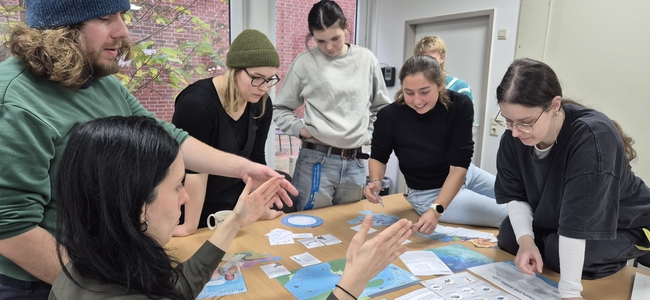
02/03/2026 | A new escape game from the Leibniz Centre for Tropical Marine Research (ZMT) in Bremen combines science and interactive gameplay. “Mila and the Secret of the Reef” invites players aged 16 and over to immerse themselves in the fascinating world of tropical coral reefs and discover how scientific research, nature conservation and social engagement are connected. Coral reefs are among the most species-rich ecosystems on Earth, but they are severely threatened by rising sea temperatures and human intervention.
The escape game, developed in cooperation with Games Institutes Austria, embeds puzzles related to environmental factors, data analysis, misinformation about reefs and social dialogue in a narrative setting. Players team up and accompany a fictional marine biologist named Mila on her research work in the South Pacific and learn in a playful way how scientific findings, local perspectives and social responsibility form the basis for effective marine conservation and sustainable use.
Learning through puzzles: Escape games as a didactic format for environmental education
“Mila and the Secret of the Reef” draws on the principle of so-called “educational escape games” – an innovative approach which learning content is conveyed through cooperative problem-solving processes and narrative storytelling. The focus is on teamwork, critical thinking, and the application of knowledge in a realistic context. The method is increasingly being used in schools, museums and educational institutions to make complex content accessible, interactive and motivating. Research institutes such as ZMT also employ this format to communicate scientific content.
Rebecca Lahl, head of ZMT's “Societal Impact” programme area, comments: “The playful setting creates a high level of engagement and identification with the topics covered. It is a format that touches people and at the same time imparts knowledge about our research.”
ZMT developed the game together with the Games Institute Austria in Vienna, which advises on the use of game-based learning as well as on learning, training and communication processes, and designs and implements game-based formats such as escape rooms.
Games designer Karen Albers (Games Institute Austria) says about the project: “Translating the topic of coral reef ecology and reef protection into various puzzles was a particularly exciting challenge. Communicating complex scientific topics in a playful way is something that is particularly close to my heart.”
The format is suitable for pupils from grammar and secondary school, students, researchers and the interested public. It can be played as part of school collaborations, workshops or science events at the ZMT in Bremen.
Info Summary:
Where to play: Leibniz Centre for Marine Tropical Research (ZMT), Bremen
Topics: Coral reefs, biodiversity, climate change, environmental communication
Subjects: Biology, politics, geography, ethics, environmental education
Format: On-site game, modular, also suitable for events and external workshops
Target group: Ages 16 and up
 Contacts
  Programme Areas
  Working Groups
  Other relevant links