


Coral reefs around Hainan under pressure: local pressures intensify the effects of climate change – integrated land-sea management can help
The ongoing loss of coral reefs in the northern South China Sea is the result of a complex interplay of global and local factors. An international long-term study, published in Nature Communications, shows that whilst climate change sets the overarching stress framework, local activities such as overfishing, nutrient inputs from agriculture or aquaculture, and coastal urbanisation act as accelerators of reef degradation. Tim Jennerjahn from the Leibniz Centre for Tropical Marine Research (ZMT) contributed to the study.
A research team led by Hainan University, together with, among others, the National University of Singapore (NUS) and the Leibniz Centre for Tropical Marine Research (ZMT), investigated a total of 102 reef sites in the waters around Hainan Island over a period of 20 years (2000 to 2020). Their analysis shows an average decline in live coral cover of 40 per cent.
Statistical modelling was used to quantify the impact of various stress factors. The results showed that local human pressures – in particular overfishing, nutrient inputs from agriculture and increasing coastal development – accounted for the majority (73%) of regional variations in coral decline. At the same time, climate change remains a key factor: Rising water temperatures weaken the resilience of the reefs and make them more vulnerable to additional pressures.
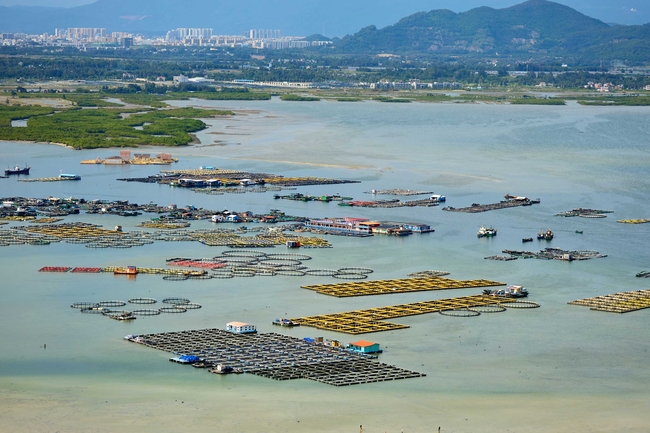
“Our analysis discovered that unsustainable fishing, nitrogen runoff from aqua- and agriculture and urban expansion not only pose additional threats, but are primarily responsible for the collapse of the reefs in this region during the period studied,” explains project lead Hongwei Zhao from Hainan University.
The study also showed regional differences in the processes of reef degradation:
- East Hainan: Overfishing and rising nutrient inputs from aqua- and agriculture facilitated a transition from coral-dominated to algae-rich systems.
- South Hainan: Urbanisation and rapidly growing tourism led to increased sewage inputs, sedimentation and habitat loss.
- Xisha Islands: Outbreaks of the crown-of-thorns starfish, which feeds on stony corals, caused widespread damage.
Integrated management combines measures on land and at sea – global climate protection measures still essential
Based on these findings, the team developed a framework for Integrated Coast Reef Management (ICRM). The approach combines measures on land and at sea and includes quantitative assessments, the identification of stress factors, and tailored strategies. These include adaptive regulation through sustainable fisheries management, the reduction of nutrient runoff from agriculture and aquaculture, the control of crown-of-thorns starfish outbreaks, and environmentally friendly coastal planning.
The researchers modelled various scenarios using the ICRM approach and were thus able to show that integrated land and marine management could potentially increase living coral cover by two to four times under conditions of ongoing global warming and prevent a collapse in reef calcification – that is, the formation of stable coral skeletons from dissolved calcium carbonate.
“Local interventions such as reducing nutrient inputs from fertilisers applied in aqua- and agriculture or strengthening sustainable fisheries represent levers that can be implemented in the short term,” says ZMT researcher and co-author Tim Jennerjahn. “However, they do not replace the need for global climate protection measures.”
Reef conservation must also be tailored to local socio-ecological conditions, says co-author Tong Liu of NUS in Singapore. “Our framework offers concrete measures for decision-makers – ranging from precision agriculture and aquaculture and the restoration of fish stocks to the expansion of marine protected areas,” says the researcher.
Publication
Xu, H., Li, Y., Liu, T.et al. Impacts of local anthropogenic stressors outpace those of climate on coral reef collapse in the northern South China Sea. Nat Commun (2026). https://doi.org/10.1038/s41467-026-70760-1
 Contacts
  Programme Areas
  Working Groups