


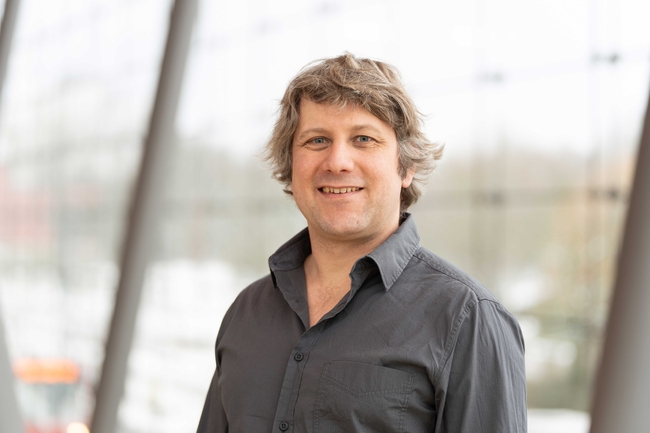
27/01/2026 | At the beginning of the year, Nils Brüggemann was appointed to a joint professorship in Earth System Modelling and Tropical Coastal Systems at the University of Bremen and the Leibniz Centre for Tropical Marine Research (ZMT). At ZMT, he will head up a strategic expansion of the institute and, together with his working group, will develop Earth system models for researching tropical coastal regions. At the University of Bremen, he will work in research and teaching in Department 01, Physics and Electrical Engineering. Nils Brüggemann is moving to Bremen from the Max Planck Institute for Meteorology (MPI-M) in Hamburg.
The joint appointment is embedded in a comprehensive strategic development of the ZMT, with which the Bremen-based research institute is expanding its scientific expertise in Earth system modelling. At the heart of the institute's expansion, known as ‘TropEcS’ (short for ‘Modelling socio-economic dimensions across Tropical Coastal Ecosystems and the Earth System’), is the development of a highly differentiated modelling approach.
The aim is to link scientific and social dynamics – from physical and ecological processes to socio-economic interactions. The goal is to significantly increase the informative value of climate projections, facilitate evidence-based political decisions and promote adaptation and resilience in the Global South.
The project is being coordinated by Nils Brüggemann, who brings his many years of experience in numerical modelling, oceanography and turbulence research to the project. "I am very much looking forward to the new challenge of developing application-oriented Earth system models in order to provide adaptation-relevant information for people in tropical coastal regions," says Brüggemann.
ZMT's Scientific Director Raimund Bleischwitz welcomes his colleague to the institute: "We are delighted to welcome Nils Brüggemann, a top-class physicist with expertise in turbulent systems and oceanography, to the ZMT, where he will make an important contribution to our research in tropical coastal regions over the coming years."
Jutta Günther, Rector of the University of Bremen says: "With the joint appointment of Nils Brüggemann, the University of Bremen and ZMT are strengthening their close strategic partnership in a key field for the future. Earth system modelling of tropical coastal systems is crucial for better understanding the complex interactions between climate, ocean and society. In particular, the integrative approach of bringing together scientific and social dynamics underlines the University of Bremen's commitment to combining outstanding basic research with high social relevance."
Brüggemann's working group Earth System Modelling will investigate the influence of ocean turbulence on tropical coastal areas. The planned models will form the basis for subsequent studies in the fields of biogeochemistry, ecology and socioeconomics. In a recent study, the physicist and his colleagues were able to show for the first time how ocean eddies influence the strength of tropical cyclones on a global average.
Connected to the North – back in Bremen after stops in Bremen, Bremerhaven, Kiel and Hamburg
For Nils Brüggemann, the move to ZMT is a return to the Hanseatic city with familiar stops. Between 2004 and 2009, he completed his physics degree at the University of Bremen and wrote his doctoral thesis at the Alfred Wegener Institute Helmholtz Centre for Polar and Marine Research in Bremerhaven. This period laid the foundation for his scientific interest in oceanography.
"Through my work in Bremen and Bremerhaven, I developed an early enthusiasm for marine research. I am now delighted to be returning to Bremen and to be able to continue my research here," says Brüggemann.
He obtained his doctorate in 2014 at the GEOMAR Helmholtz Centre for Ocean Research in Kiel and the University of Hamburg. After positions at the University of Hamburg and TU Delft (Netherlands), Brüggemann joined the Max Planck Institute for Meteorology (MPI-M) and the University of Hamburg in 2017, where he conducted research in the transregional project ‘TRR181 – Energy Transfers in Atmosphere and Ocean’. Since 2022, he has been head of the ‘Complex Modelling and Extreme Computing’ group at MPI-M together with Peter Korn. He remains connected to his former employer through the co-supervision of two doctoral students and one postdoc.
 Contacts
  Programme Areas
  Working Groups