

Supported by ZMT: Young researcher from Bremerhaven wins regional competition and secures a place in the state competition of "Jugend forscht"
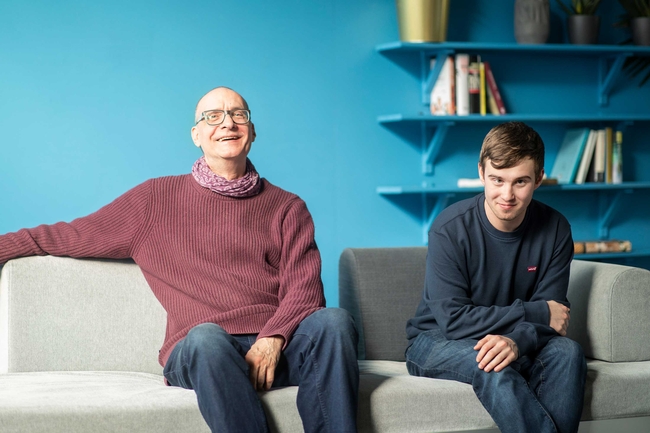
A remarkable success for the next generation of scientists: Vitalii Serbin from the Carl von Ossietzky School Centre impressed the jury with his research project at this year’s regional and state competitions of ‘Jugend forscht’. The development of his field fluorometer was recognised in the Technology category. He also received the Special Prize for Environmental Technology and the Special Prize for Quality Assurance through Non-Destructive Testing.
His supervisor, Matthias Birkicht from the Leibniz Centre for Tropical Marine Research (ZMT), received the Special Prize for particularly dedicated project supervisors from ‘Jugend forscht’ and will travel to Dortmund for three days to discuss STEM topics with fellow experts.
As part of his award-winning project, 19-year-old Vitalii developed a cost-effective, modular measuring device which enables him, amongst additional environmental parameters, to quantitatively and selectively determine the environmental toxin naphthalene and its derivatives within the parts per billion (ppb) range. Even without enrichment procedures, this is approximately 100 times more sensitive than commercially available rapid tests and lies below the visibility and odour thresholds.
The portable, mains-independent device can make measurements within the limits set by the OGewV (Surface Water Ordinance, May 2020, Annex 8) and thus serves as a cost-effective screening instrument (< 200 EUR) for environmental monitoring. From 2027, this method will become significantly more relevant in the EU (OSPAR), although in Germany the discharge of scrubber wash water into inland waters and the ports situated there is already prohibited.
Naphthalene is classified as a PAH (polycyclic aromatic hydrocarbon). In heavy fuel oil, naphthalene and its derivatives account for 95% of the total PAHs. They also constitute the majority of PAHs in wash water from open exhaust gas cleaning systems (scrubbers) on the more than 5,000 ships (one third of the global merchant fleet) that operate worldwide using heavy fuel oil and open scrubbers. Closed systems account for less than 1% of exhaust gas cleaning systems. The wastewater generated by the use of scrubber technology is discharged into the water during ship operations. Negligent handling of hazardous substances and incidents result in ecosystems being heavily contaminated by PAHs and other environmental toxins.
From 1 July 2027, a far-reaching ban on the discharge of wash water from open-loop scrubbers into inland and port waters of the North-East Atlantic will come into force under the OSPAR Convention. This ban aims to protect the environment from acidic, main pollutants in wash water (oil, PAHs, turbidity, nitrate, heavy metals and pH). However, the wastewater may still be discharged into the sea outside the prohibited zones, as it is politically difficult to enforce the bans in the open sea as well. The fact sheet from the German Environment Agency (2025, in German) explains this situation in great detail and this study report from the German Environment Agency (2020, in English & German) as well.
“I’ve chosen this topic because it is particularly important to me to investigate the major problems of oil pollution caused by industry and human error,” Vitalii Serbin explains. “I asked myself whether it is possible to monitor oil and wash water pollution using a low-cost measuring device and a method that saves both time and money. This is particularly efficient because rapid screening saves on high costs and manpower, and one only needs to resort to the certified laboratory method in the event of a positive result in order to obtain legally admissible data.”
Originally, Vitalii Serbin wanted to build an autonomous measuring robot that analyses the oil components of marine sediment in situ. “I had first hoped it would be feasible to develop a pressure-resistant housing for the necessary electronics, a gripper, a drive, a control system, a transmitter and an analysis module,” said the student. “Ultimately, for reasons of cost and time, I limited myself to the development and testing of the analysis module.”
The field fluorometer was developed in collaboration with the Leibniz Centre for Tropical Marine Research (ZMT). Vitalii Serbin was supervised by Dipl.-Ing. Matthias Birkicht (Experimental Aquaculture Working Group) at the CvO Secondary School and received logistical support from his teacher, Ms Pertlicsek.
“We’re delighted to be able to inspire young people to take an interest in science and sustainability,” said the supervisors. “This success shows just how important collaboration between schools and research institutions.
 Contacts
  Programme Areas
  Working Groups