

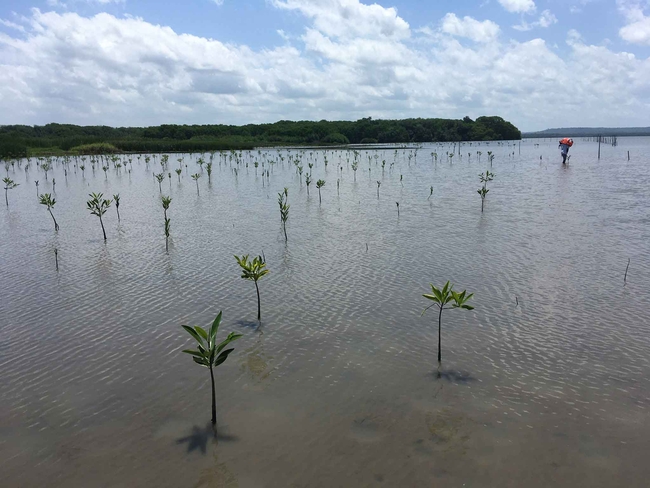
16/02/2026 | The concept of ‘ecosystem co-design’ has been included in the United Nations World Ocean Assessment (WOA III) report on the state of the oceans. The approach, developed at the Leibniz Centre for Tropical Marine Research (ZMT), aims to make the protection and (re-)establishment of coastal ecosystems more effective by combining scientific findings with local knowledge and requirements. This integration results in protective measures that are both scientifically sound and locally viable. This brings a methodology developed at the ZMT into the focus of international environmental policy.
Martin Zimmer, mangrove ecologist at the Leibniz Centre for Tropical Marine Research (ZMT), developed the idea of ecosystem co-design almost 10 years ago. He has now contributed to the United Nations' third World Ocean Assessment (WOA III) and shared his expertise as a member of the international pool of experts in the third global ocean status report.
The report will provide a comprehensive, scientifically sound assessment of the state of the oceans for the period 2021 to 2025. It will serve as a key basis for decision-making by policymakers and international bodies, particularly in the context of the UN Sustainable Development Goals (especially SDG 14).
The annotated outline of the report was published in December. Shortly after, the UN General Assembly approved the Executive Summary that is now available online: LINK. It summarizes the thematic focus of the assessment – from marine ecosystems and conflicts of use to socio-economic aspects. The individual chapters are written by interdisciplinary teams of authors comprising more than 650 experts. The full report is due to be published in the coming months.
Martin Zimmer coordinated the subchapter on “Intertidal Zones”, which assesses the state and development of coastal ecosystems based on global and regional trends. The analysis shows increasing pressure from sea level rise, changes in temperature and extreme events as a result of climate change, and direct human interventions such as coastal development, pollution, and intensive use.
In many regions, a decline in biodiversity and a weakening of key ecosystem services have been observed, including natural protection against erosion and storm surges, as well as their importance as breeding, nursery and refuge areas for marine species. At the same time, the assessment emphasizes that well-preserved intertidal zones are highly adaptable and play a key role in climate adaptation and sustainable coastal development. The report thus underscores both the urgency of protection and the considerable potential of these ecosystems for society and the economy.
 Contacts
  Programme Areas
  Working Groups