


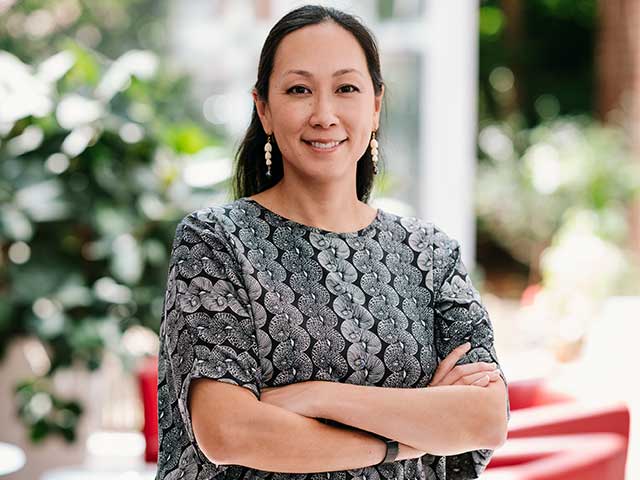
30/01/2026 | For the last half year Marie Fujitani has been a Professor for Human Geography with a focus on Marine and Coastal Sustainable Development at the Institute of Geography of the University of Bremen. In her role as a cooperation professor, she also leads the working group “Deliberation, Valuation and Sustainability” and the Program Area “Coastal Transformation” at the Leibniz Centre for Tropical Marine Research (ZMT).
An interdisciplinary marine social scientist, her research focuses on social, economic, governance, and environmental dimensions of sustainable coastal livelihoods in the tropics, with a focus on tourism, fisheries, and aquaculture. Central to her research is the analysis of sustainability transformations, including the identification of leverage points, shifts from undesirable stable states, and the role of values and behavioural change in enhancing equity and multi-dimensional community well-being.
Her current research focuses on sustainability transformations in tourism. Employing mixed-method and participatory approaches, her research is strongly interdisciplinary and aims to generate knowledge that is both scientifically robust and socially relevant. She works closely with local communities, policymakers, and other societal actors to support context-sensitive and scalable pathways toward sustainable coastal development.
Her work contributes to broader sustainability discourse by linking empirical case studies from the tropics with conceptual advances on transformation processes in social-ecological systems. A key aim is to bridge science, policy, and practice in addressing complex coastal sustainability challenges.
Fujitani’s personal connection to her research is deeply rooted in her upbringing in Hawai‘i. She recalls how concerns over environmental vulnerability and over-tourism shaped her understanding of the fragile balance between livelihoods and ecosystems. “Coastal communities are on the front line of environmental change, economic uncertainty, and global development pressures,” she explains. Tourism, she notes, can generate much-needed income, but can also intensify inequality and environmental degradation if not carefully governed.
Reflecting on her new role, Fujitani expresses both gratitude and a strong sense of responsibility. While thankful for the mentors, colleagues, and family who supported her journey, she also sees her professorship as an opportunity to shape future research directions, mentor early-career researchers, and contribute to institutional change processes.
What drives Marie Fujitani’s research:
“I remember as a child in Hawai’i, the undercurrent of worry during storms, fearing that the boats would stop coming. People would stockpile water and toilet paper. Years later, that worry shifted. We began to fear that too many boats and planes were arriving. As nearly ten times as many tourists as residents came to our islands, the fragile balance between livelihoods and the life of the land became increasingly visible. Some changes were easy to see, others unfolded silently beneath the surface, such as our small and fragile freshwater supplies being slowly drained and polluted.
I study sustainable coastal livelihoods because coastal communities are on the front line of environmental change, economic uncertainty, and global development pressures. I study tourism because it is a powerful lens to focus the interaction between societies, environments, economies, and cultures. Tourism can generate livelihoods and lift people out of poverty, but it can also intensify social inequalities and environmental pressures. I work to support livelihood pathways that are resilient, equitable, and compatible with the health of coastal and marine environments.
Hawai‘i in the popular imagination is a place to escape your worries on a white sand beach. Yet in scientific circles, it is perhaps better known as ‘the extinction capital of the world.’ And there is nowhere like it.
Thus, it is my great joy to be named Leibniz Professor for Human Geography with focus on Marine and Coastal Sustainable Development, and a great privilege to devote my life to pressing sustainability challenges. To contribute to a vibrant future for my island home and for the global community, knowing these futures are deeply intertwined. And to strive to live my kuleana through stewardship, collaboration, and ethical action, to live pono, and every single moment, live aloha.”
Professor Marie Fujitani
 Contacts
  Programme Areas
  Working Groups